Jun 16

One part of the vehicle that saw the most modifications and changes were the seats-not so much their shape as their covering, the object being always to reduce the price.
Another major innovation brought about by Ford was the chain-production line. He realized that it would be much simpler, more practical, and quicker if , when assembling the vehicle, the workers could draw the various components from suitable containers placed beside the production line, rather than going to the various storerooms for them, which meant they had constantly to by moving from place to place. In this way he managed to reduce the assembly time from 12 hours to an hour and a half.
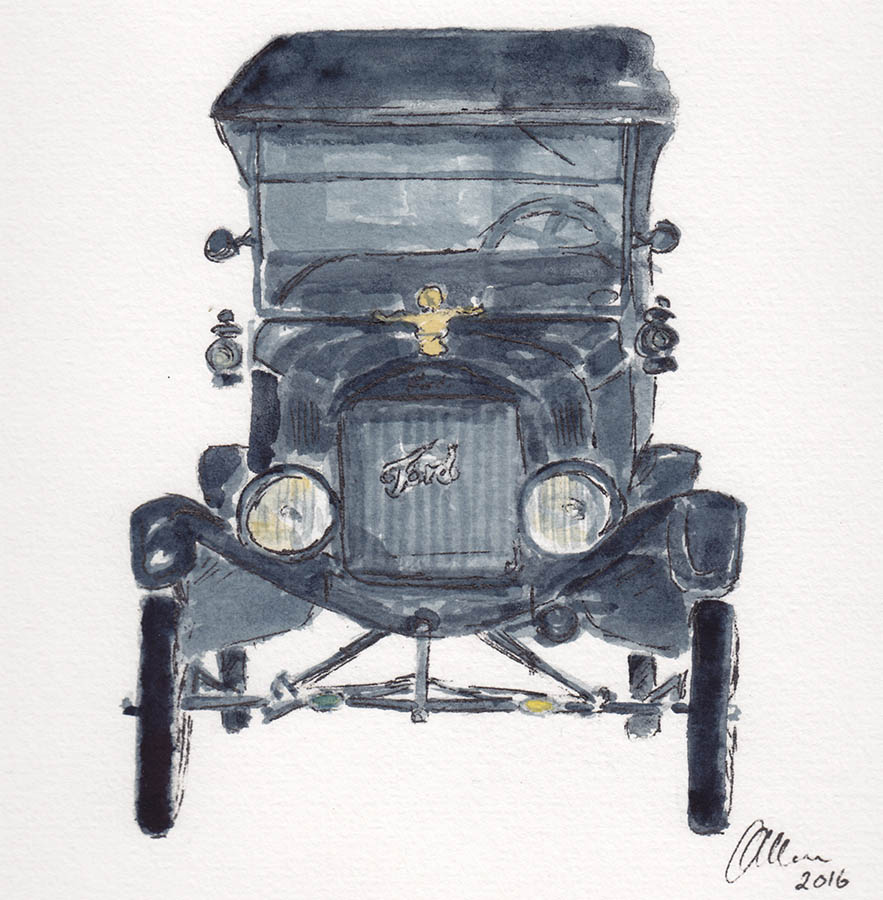
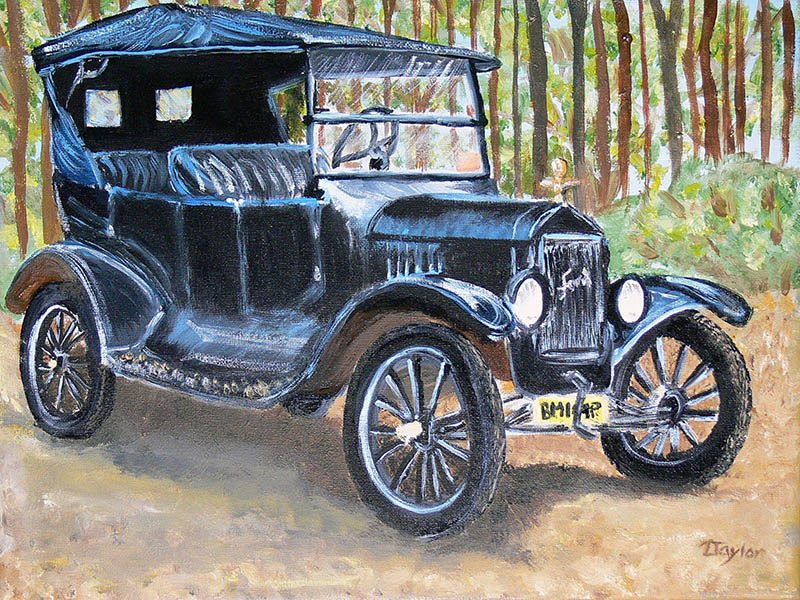
Car : Ford Model T
Year : 1908
Engine : 4 cylinders in line
Bore and stroke :95×102 mm
Cylinder capacity : 2890 cc
Gears : 2 forward
Brake horse power : 22
Maximum speed : 45 mph
Wheelbase : 8 ft 4 ins (2.54 m)
Suspension : front and back :transverse leaf- springs
The Model T was first market in 1908, but the models produced after April 1909 were so different from the original that they may be thought of almost as different cars. In the end Ford officially declared that there were 2,500 vehicles of 1909 vintage. The first thousand were placed in a separate category. They differed from the others in having two external levers (brake and reverse). These levers were abandoned in February 1909, in favour of the three-pedal system. Ford invited the owners of the first thousand vehicles to have them brought up to date for the very reasonable sum of $15, on condition that they returned the parts that were replaced. Basically, therefore, the true 1908 models, extremely rare today, are those carrying a serial number of under a thousand. With the outbreak of war and the need to reduce all gasoline consumption, production of the T was hit. The original 22 bhp was reduced progressively in 1917 to 20. The engine speed was 1,500 revs, and the maximum speed of the vehicle about 36 mph. With the occasional rare exceptions, up until 1911 the bodywork was made of wood. After 1911, sheets of metal on a wooden frame were used. Two new models went into production in 1915, the 2-door sedan and the coupelet, the first convertible. That same year quite major stylistic and other more essential changes were introduced: and electrical ignition system , fenders (straight at the front, and curved at the back), a lower hood , and a horn. In 1917 it acquired a regular ‘new look’: the fenders, both front and back, became curved, the hood was widened, and the brass radiator was widened, and the brass radiator was replaced by a black-painted one. In 1919 there were important technical alterations (choke and removable wheel-rims). In 1923 the body was lowered , and the 4-door model was introduced.
Ford Model T

Jun 16

Henry Ford always stubbornly resisted changes by insisting that, ‘so far as I can see, the only trouble with the Ford car is that we can’t make it fast enough’. Prices varied considerably: in 1910 the cheapest model cost $900, in 1912 $590, in 1913 $525, in 1914 $440, in 1915$ 390, in 1916 $345, and the same in 1917. In 1918 the same model rose to $500, remaining the same in 1919, and going down again in 1920 to $440. In 1925 it was selling for $260, but in 1926 rose back to $360 , where it stayed during 1927 which was its last year of production.
In June 1927, after 19 years, the T went out of production. The last one bore the serial number 15007033. It is said that on the day the T was taken off the assembly lines, Ford left the factory in a rage. He still believed in the car, although the market response showed that it was outdated.
In fact, looking at production figures throughout its whole lifespan, it can be seen that the peak year was 1923, with 2,055,309 cars made (as compared with only 380,741 in 1927).
The T was replaced by the A, thus going back to the beginning of the alphabet. It had a 4-cylinder engine, developing 40 bhp at 2,300 revs, and the cheapest version cost $495. By now, however, the threatening shadow of Chevrolet was appearing on Ford’s horizon.
In 1927 the Model A certainly represented a step forward from the T, but Ford’s personal aversion to the 6-cylinder engine kept the A in 4-cylinder class. It was converted to 8-cylinder V in 1932 , when Ford devised a method of building such an engine cheaply, in a single cast-iron block, with aluminium pistons. The 3-speed gearbox became synchronized, and safety glass was incorporated into the more expensive models.
Many parts of the V8 were interchangeable with parts on the Model B, a more advanced car than the A. The V8 had splash lubrication, like most Fords, and the mechanical breaks were designed to bring the car to a halt from 60 mph within a few yards. It was an instant success and was also built in England, France (by Matford), and in Austria. The engine was bought by Chenard-Walcker in France and Allard in England among many small manufacturers. The engine was extensively used in American army vehicles during the Second World War.

Car : Ford Model V8 Model 18
Year : 1932
Engine : 7 cylinders V
Bore and stroke :77.8?95.2 mm
Cylinder capacity : 3612 cc
Gears :3 forward
Brake horse power : 65
Maximum speed : 75 mph
Wheelbase : 8 ft 10 ins (2.69 m)
Suspension : front and back :transverse leaf- springs
ford-model-v8

Jun 16

Franklin Series 17
Car : Franklin Series 17
Year : 1933
Engine : 12 cylinders V, air-cooled
Bore and stroke :82.5×107.5 mm
Cylinder capacity : 6810 cc
Gears : 3 forward
Brake horse power : 150
Maximum speed : 95 mph
Wheelbase : 12 ft 0 ins (3.65 m)
Suspension : front and back :semi-elliptic leaf- springs
The main feature of Franklines (the firm founded by Herbert H. Franklin, Syracuse, New York) was their air-cooled engines, which were built into every car. John Wilkinson in 1902 designed an air-cooled engine with 4 cylinders and overhead valves. The absence of a radiator, and the use of light metals made the Franklin both light and manageable, as well as reliable. The company demonstrated the reliability of its cars by organizing, and winning, a rally across the whole continent.
Graham Streak
Franklin started thinking about a 12-cylinder V engine in 1928, with the assistance of Glen Shoemaker. In building the assembly line he contracted debts of $5,000,000; the economic crisis led to the failure of the company in 1932, and the Series 17 was sold by the receivers. In fact, the car was not well suited to the times. It weighed about 3 tons (3,000 kg)- as if to compensate for the lightness of the previous models-and although it could reach 95 mph, its gasoline consumption was in the region of 5 to 7 miles per gallon, and it cost $4,200. Franklin himself was an interesting person, having been editor of a newspaper, and then a match manufacturer, before becoming involved with the manufacture of motor cars.

Jun 16

Franklin Series 17
Car : Franklin Series 17
Year : 1933
Engine : 12 cylinders V, air-cooled
Bore and stroke :82.5×107.5 mm
Cylinder capacity : 6810 cc
Gears : 3 forward
Brake horse power : 150
Maximum speed : 95 mph
Wheelbase : 12 ft 0 ins (3.65 m)
Suspension : front and back :semi-elliptic leaf- springs
The main feature of Franklines (the firm founded by Herbert H. Franklin, Syracuse, New York) was their air-cooled engines, which were built into every car. John Wilkinson in 1902 designed an air-cooled engine with 4 cylinders and overhead valves. The absence of a radiator, and the use of light metals made the Franklin both light and manageable, as well as reliable. The company demonstrated the reliability of its cars by organizing, and winning, a rally across the whole continent.

Franklin started thinking about a 12-cylinder V engine in 1928, with the assistance of Glen Shoemaker. In building the assembly line he contracted debts of $5,000,000; the economic crisis led to the failure of the company in 1932, and the Series 17 was sold by the receivers. In fact, the car was not well suited to the times. It weighed about 3 tons (3,000 kg)- as if to compensate for the lightness of the previous models-and although it could reach 95 mph, its gasoline consumption was in the region of 5 to 7 miles per gallon, and it cost $4,200. Franklin himself was an interesting person, having been editor of a newspaper, and then a match manufacturer, before becoming involved with the manufacture of motor cars.
Graham Streak

Jun 16

Franklin Series 17
Car : Franklin Series 17
Year : 1933
Engine : 12 cylinders V, air-cooled
Bore and stroke :82.5×107.5 mm
Cylinder capacity : 6810 cc
Gears : 3 forward
Brake horse power : 150
Maximum speed : 95 mph
Wheelbase : 12 ft 0 ins (3.65 m)
Suspension : front and back :semi-elliptic leaf- springs
The main feature of Franklines (the firm founded by Herbert H. Franklin, Syracuse, New York) was their air-cooled engines, which were built into every car. John Wilkinson in 1902 designed an air-cooled engine with 4 cylinders and overhead valves. The absence of a radiator, and the use of light metals made the Franklin both light and manageable, as well as reliable. The company demonstrated the reliability of its cars by organizing, and winning, a rally across the whole continent.

Franklin started thinking about a 12-cylinder V engine in 1928, with the assistance of Glen Shoemaker. In building the assembly line he contracted debts of $5,000,000; the economic crisis led to the failure of the company in 1932, and the Series 17 was sold by the receivers. In fact, the car was not well suited to the times. It weighed about 3 tons (3,000 kg)- as if to compensate for the lightness of the previous models-and although it could reach 95 mph, its gasoline consumption was in the region of 5 to 7 miles per gallon, and it cost $4,200. Franklin himself was an interesting person, having been editor of a newspaper, and then a match manufacturer, before becoming involved with the manufacture of motor cars.
Hudson 37

Jun 16

K.R.I.T. 25/30HP
Car : K.R.I.T. 25/30HP
Year : 1912
Engine : 4 cylinders in line
Bore and stroke :95×102 mm
Cylinder capacity : 2890 cc
Gears : 3 forward
Brake horse power : 30
Maximum speed : 42 mph
Wheelbase : 9 ft 0 ins (2.74 m)
Suspension : front :semi-elliptic leaf- springs; back : elliptic leaf- springs
K.R.I.T. did not survive long enough in the turbulent early years of the American car industry. Built by Kenneth Krittenden between 1909 and 1916, these cars were thoroughly orthodox, the one exception being the 1912 model illustrated here , which had elliptic rather than semi-elliptic leaf-spring rear suspension. Another distinguishing sign was a certain richness of colour on the body. The 1914 Touring Car L came in blue with grey wheels. It cost $1,050, including top, lights, choke, windshield, speedometer, and detachable wheels, and this was thus a strong selling feature. Punctures were by no means uncommon! Strangely enough , one of the characteristics specified by the company was the steering-wheel positioned on the left. The controls (gears and brakes) were also on the left. Not all manufacturers followed the same criteria at this stage, and the position of the steering-wheel and controls was probably a decisive element in the prospective purchaser’s mind.
The 25/30 was made throughout the period 1912 to 1915. Although the company tried to make headway in the difficult and highly competitive cheap car market, not surprisingly it was defeated in the battle with the giant manufacturers.
K.R.I.T. 25 30HP

Jun 16

Franklin Series 17
Car : Franklin Series 17
Year : 1933
Engine : 12 cylinders V, air-cooled
Bore and stroke :82.5×107.5 mm
Cylinder capacity : 6810 cc
Gears : 3 forward
Brake horse power : 150
Maximum speed : 95 mph
Wheelbase : 12 ft 0 ins (3.65 m)
Suspension : front and back :semi-elliptic leaf- springs
The main feature of Franklines (the firm founded by Herbert H. Franklin, Syracuse, New York) was their air-cooled engines, which were built into every car. John Wilkinson in 1902 designed an air-cooled engine with 4 cylinders and overhead valves. The absence of a radiator, and the use of light metals made the Franklin both light and manageable, as well as reliable. The company demonstrated the reliability of its cars by organizing, and winning, a rally across the whole continent.
Kissel 8 75
Franklin started thinking about a 12-cylinder V engine in 1928, with the assistance of Glen Shoemaker. In building the assembly line he contracted debts of $5,000,000; the economic crisis led to the failure of the company in 1932, and the Series 17 was sold by the receivers. In fact, the car was not well suited to the times. It weighed about 3 tons (3,000 kg)- as if to compensate for the lightness of the previous models-and although it could reach 95 mph, its gasoline consumption was in the region of 5 to 7 miles per gallon, and it cost $4,200. Franklin himself was an interesting person, having been editor of a newspaper, and then a match manufacturer, before becoming involved with the manufacture of motor cars.
Kissel 8 75

Jun 16

La Salle
Car : La Salle
Year : 1932
Engine : 8 cylinders V
Bore and stroke :85.4×125.4 mm
Cylinder capacity : 5743 cc
Gears : 3 forward
Brake horse power : 115
Maximum speed : 85 mph
Wheelbase : 10 ft 10 ins (3.30 m)
Suspension : front : independent with spiral springs; back : semi-elliptic leaf- springs

La SalleThe La Salle was not just another model from General Motors. It was a series created strategically by the biggest car manufacturing firm in the world to fill a gap in the market between the Buick and the Cadillac. It started well in 1927, with 27,000 vehicles being made. The price was tempting ($3,000), and the bodywork was attractive, being along the lines of the Hispano-Suiza. Apart from anything else, these cars, together with the Cadillacs, were the first to have wholly synchronized gears. In the end, however, rather than being halfway between the Buick and the Cadillac, the La Salle finished up as a poor imitation of the Cadillac, unable to vie with it even in price. At the same time, the economic depression had forced General Motors to produce two commercially distinctive vehicles whilst keeping them as similar as possible on the engineering side. In 1931 both cars shared the same 5784 cc engine developing 115 bhp. The La Salle had a servo-assisted clutch, mechanical feed-pump, and servo-brakes. Yet despite these qualities, and a price difference of $400, sales of Cadillacs were more than double those of La Salles. The 1934 model had straight-8 engines, unlike any Cadillac. A return to V-8s came in 1937, and the La Salle was discontinued after 1940.

Jun 16

Lincoln Zephyr Fastback
Lincoln KV 12
Car : Lincoln Zephyr Fastback
Year : 1936
Engine : 12 cylinders V
Bore and stroke :69.8×95.2 mm
Cylinder capacity : 4369 cc
Gears : 3 forward
Brake horse power : 110
Maximum speed : 90 mph
Wheelbase : 10 ft 2 ins (3.09 m)
Suspension : front and back : transverse leaf- springs
Car : Brough Superior V-12
Year : 1938
Engine : 12 cylinders V
Bore and stroke : 69.8×95.2 mm
Cylinder capacity : 4369 cc
Gears : 3 forward
Brake horse power : 110
Maximum speed : 90 mph
Wheelbase : 10 ft 8½ ins (3.21 m)
Suspension : front and back : semi-elliptic leaf- springs
Of the makes still on the American market, Lincoln, founded in 1920,is one of the most recent. It resulted from irreconcilable differences of opinion between the former Cadillac designer Henry Leland and the president of the company, William Crapo Durant. Although 65 years old, Leland left General Motors and founded Lincoln, named after the American president. In 1922 Henry Ford bought the company, intending himself to enter the de luxe and prestige section of the market. Ford took full advantage f Leland’s acknowledged expertise, and Leland immediately started to produce cars for the top end of the market, with 8-cylinder V engines, slightly different from those he had designed for Cadillac in having a V angle of 60° rather than 90°. This engine was so successful that it remained practically unchanged for over ten years. Going straight to the best body designers of the time, they created a car that combined both elegance and mechanical excellence.
Lincoln Zephyr Fastback
The Zephyr Fastback was one of the big attractions of the 1936 New York motor show. Its chief characteristic was its 4387 cc, 12-cylinder engine, with seven bearings, and hydraulic tappets. It developed 110 bhp and had a maximum speed of about 90 mph. An unusual feature was the position of the headlights which were built into the fenders.
Unlike the Ford V-8 , the Lincoln V-12 engine was not fitted to many European makes of car, but one company which did use it was Brough Superior. In late 1937 they announced a beautiful sedan with underslung chassis and body by Charlesworth. Three chassis were laid down, but only one Brough Superior V-12 was completed.
Lincoln used more 12-cylinder engines than any other make (over 150,000 between 1932 and 1948). Later, however, 12 cylinders were abandoned; from 1948 onwards Lincoln used only 8-cylinder V engines, and after 1952 one with overhead valves. In 1955 a model was offered at $10,000- The most expensive in absolute terms, this being a way of making the car into a luxury article, as it had in fact always been, to rival the Cadillac. This car was called the Continental Mark II and is sometimes thought of as a separate make from Lincoln.